Showing posts with label Supreme Court. Show all posts

Saturday, April 7, 2012

Humor and the Abortion Debate


Humor and satire is so very little seen when it comes to the abortion debate, unless seen in the fantastic It’s Always Sunny in Philadelphia. Recently pro-choice politicians have taken to using humor as an effective means of combating restrictive and humiliating laws restricting abortion.


Since the Supreme Court case of Roe v. Wade (1973) discussions on abortion and its legality have dominated the political, moral, and social climate of America. One of the primary reasons for the decision that allowed for women to get abortions was the fact that laws banning abortion violated a woman’s privacy by having the government monitor a woman’s decisions over her body. Since Roe politicians, in a great many cases male, have made laws that forced women who want to get abortions: to get ultrasounds shown of the fetus, to get invasive procedures done prior to an abortion, or to get “counseling” on the effects an abortion will have. In response to this some female legislators have brought forth bills that would force men who use the male erectile dysfunction drug Viagra to: learn about the potential dangers of Viagra, have rectal exams for health reasons, watch videos on the effects of Viagra, and have counseling on the benefits of a celibate lifestyle.

I find the laws brought forth by female legislators to be a brilliant way of satirizing the invasive laws male legislators have passed to prevent abortion. I think it is a great way of showing that women should not have draconian abortion prevention measures thrust upon them. By showing how invasive and personal the government intervening in sexual matters is, female legislators have shown the hypocrisy of male legislators in approving invasive health laws that only affect women. It is even more jarring when many conservatives have come out against a government-mandated vaccine for young women that prevent cervical cancer. Conservatives have argued that the mandatory vaccine against cervical cancer violates the privacy of individuals and the right to refuse these vaccines. It is ironic that these same conservatives often approve of measures that do the same thing in abortion cases.


I personally believe that there should be no restrictions on abortion and that the government has no right to interfere in women’s health matters, including abortion.

The Importance of Sweatt v. Painter


Sweatt, the African-American at the center of the case

The Supreme Court case Sweatt v. Painter (1950) was a landmark civil rights case that is often overshadowed by the better-known Brown v. Board of Education. The case of Sweatt v. Painter dealt with an African-American, Sweatt, being denied entry into the School of Law at the University of Texas. Sweatt was denied entry on the ground that he was an African-American and Texas state law forbade the integration of schools. A separate Law School was set up for African-Americans in order to maintain the façade of equality. Sweatt challenged this separate Law School made for African-Americans, arguing that the accommodations were not equal to the School of Law at the University of Texas. Eventually the case was brought before the Supreme Court, which decided that the accommodations of the segregated Law School were not equal and that under the Equal Protection Clause of the 14th Amendment Sweatt had the right to attend the School of Law at the University of Texas.

Thurgood Marshall, future Supreme Court justice, argued the case for the NAACP
The Supreme Court case of Sweatt v. Painter was important because the justices came to the decision that “separate, but equal” was an oxymoron that did not provide true equality. By ruling that the segregated law schools were not equal the Supreme Court also undid the precedent set by Plessy v. Ferguson.
I find the case of Sweatt v. Painter to be remarkably important. It showed that gradually, the Supreme Court was ruling that the decision in Plessy v. Ferguson was erroneous. By ruling on a case that only applied to higher education the Supreme Court also showed that it was taking small steps towards ruling that segregation in all public schools was unconstitutional, as seen in Brown v. Board of Education. I find it interesting that Brown v. Board of Education is often shown as the turning point in Civil Rights cases, when four years earlier the case of Sweatt v. Painter showed a shift in the opinion of the Supreme Court towards race and equality.


The Supreme Court of Sweatt v. Painter signaled a paradigm shift on the Supreme Court’s views of race and civil rights. Sweatt v. Painter nullified the precedent of over fifty years set by Plessy v. Ferguson that segregation was “separate, but equal”. It was the first small steps towards racial equality in America. 

Wednesday, March 21, 2012

The Dangers of President Franklin Roosevelt’s Court Packing Scheme

President Roosevelt
President Roosevelt grew increasingly frustrated throughout the 1930’s as the Supreme Court declared many of Roosevelt’s New Deal programs unconstitutional. Indeed four of the justices on the Supreme Court were such a hindrance to Roosevelt that they became known as the “four horsemen of the apocalypse” due to them striking down many of the Roosevelt’s New Deal laws.

Roosevelt and his many New Deal programs
Roosevelt’s solution in 1937 to the problem with the Supreme Court was to stack the court with more justices, effectively nullifying any dissent from the “four horsemen” and to require that justices over the age of 70 retire. Conveniently the requirement for justices over the age of 70 to retire would have forced some of the “four horsemen” to retire.


The plan eventually failed to gain support due to many seeing Roosevelt as trying to exert Executive authority over the Judicial Branch. Another reason the court packing plan failed was because the Supreme Court became more moderate on New Deal programs, as seen in West Coast Hotel v. Parrish, which upheld the legality of minimum wage.


Although I find President Franklin Roosevelt to be one of America’s greatest Presidents I find the actions he took in trying to subvert the authority of the Supreme Court to be unsettling. I understand why Roosevelt found it upsetting that the Supreme Court was overturning many of his New Deal programs, but what he tried to do was still wrong. I find it greatly disturbing that Roosevelt would undermine the system of checks and balances in order to get his way. If Roosevelt succeeded in his court-packing plan the results would have been catastrophic. If Roosevelt succeeded the court could have been rendered impotent due to the Executive branch exerting control over the Judicial branch. Furthermore it would have set a precedent where a President could dismantle the Judicial branch if they disagreed with the courts. This could have had profound implications for the Civil Rights movement if leaders could simply choose to undermine the authority of the courts.

One of the core tenants of the American government is the system of checks and balances, where each branch provides a check on the other in order to prevent a totalitarian government from taking shape. By trying to subvert the system of checks and balances Roosevelt was undermining one of the core tenants of American democracy. 

The Importance of Near v. Minnesota


The importance of the press
The 1931 Supreme Court case of Near v. Minnesota was one of the first major Supreme Court cases dealing with censorship of the Press. The case centered on the actions of Jay Near and a Minnesota state law prohibiting a newspaper from making malicious and untrue statements. 
An example of Near's paper and the charges it brought forth
Jay Near was the owner of a Minnesota newspaper, The Saturday Press, which he used to make anti-Semitic and racist remarks. Near accused the police chief of Minneapolis, along with the Mayor of Minneapolis and other prominent citizens and government officials of corruption. Along with corruption charges Near wrote on how Jewish gangs were running amok unchallenged in Minneapolis and how the Jews had most of the power in Minnesota. Near was eventually challenged by local officials under Minnesota state law and the case went all the way to the Supreme Court. The Supreme Court ruled that Near’s rights were violated under the Due Process clause of the 14th Amendment which prohibits states from restricting essential rights.
I find the case of Near v. Minnesota to be one of the more important Supreme Court cases in American history. As vile and racist as the actions of Near were I still believe that he should have been allowed to publish what he wanted. The Minnesota state law was far too broad to be acceptable and the potential for abuse was staggering since lawmakers could ban newspapers if they found content in it that was objectionable. By repealing the Minnesota state law the Supreme Court struck a major blow against censorship and helped to ensure the continued survival of the Press. After all, if leaders found content objectionable in newspapers they could have them shut down by claiming that they ran untrue or malicious stories. 

Saturday, March 3, 2012

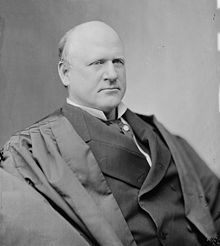
The Wisdom and Courage of Justice Harlan


The Supreme Court of 1896

The 1896 Supreme Court Case Plessy v. Ferguson proved to be a monumental blunder for the Supreme Court on the level of the 1857 Dred Scott v. Sanford case. The black eye given by the case persists till this day and the Justices associated with the case have been widely repudiated by legal scholars, save one Justice who dissented in the case.

Justice Harlan
The Case of Plessy v. Ferguson involved a Louisianan man of mixed racial heritage who boarded a train designated as useable only by whites. It was against the law in Louisiana at the time to disobey the segregation that took place on transportation and all other manner of life. The man, Plessy, was arrested but challenged the constitutionality of the segregation put in place in Louisiana. The Supreme Court ruled against Plessy in a 7-1 decision in which the court stated that the segregated facilities were “separate but equal.” Many of the Justices cited the autonomy of the state to decide these laws as a reason for deciding against Plessy.

The Effects of the Plessy case
The one Justice who dissented in the case was Justice Harlan. It should be made clear that Justice Harlan was no huge promoter of the equality of races, saying in his dissent, “The white race deems itself to be the dominant race in this country. And so it is, in prestige, in achievements, in education, in wealth and in power.” This statement shows that Justice Harlan himself held some views that would today be considered racist. However his decision to dissent in the case showed that he was remarkably progressive for his time in regards to civil rights. Harlan had the foresight to see that the case involving Plessy would later be seen negatively by historians. Many Justices wish to remain favorably in the eyes of historians in order to ensure that their legacy remains unsullied and Harlan accomplished this task. Harlan himself stated that the Plessy case would come to be seen as negatively as the Dred Scott case. Justice Harlan proved to be on the right side of history with his decision and is still honored to this day for it.