Showing posts with label Constitution. Show all posts

Saturday, April 7, 2012

Thomas Jefferson and the “Wall of Separation” Between Church and State


Thomas Jefferson

Thomas Jefferson’s letter to the Danbury Baptists in 1802 concerning the United States and religion ended up having profound effects on how the Supreme Court and to a lesser extent the general public view the place of religion in government. Jefferson, who held various views on religion throughout his lifetime, wrote to the Danbury Baptists in 1802 that there should be “wall” set up that divides church and state. This idea was used by the Supreme Court in the latter half of the 20th Century to justify the separation of church and state.


It is my personal belief that religion has no place in the government of the United States. I interpret the Establishment Clause of the Constitution as saying that the United States’ government shall not establish a state religion or aid any religions in any way. It is my belief that the Founding Fathers wanted to differentiate themselves from other countries of the time such as France and Great Britain that had state religions. 

Some have argued that America is a Christian country founded on Christian morals. My response to this belief is that many of the Founding Fathers were deists or held non-traditional views on religion, such as Thomas Jefferson. If we lived in a society where the church and state were fused it would be a system where the minority is oppressed or encouraged to believe in the ways of the majority. It is my firm belief that in order to maintain a free and open society religion must not enter the public square and it must be kept as a private matter. 

Wednesday, March 21, 2012

The Dangers of President Franklin Roosevelt’s Court Packing Scheme

President Roosevelt
President Roosevelt grew increasingly frustrated throughout the 1930’s as the Supreme Court declared many of Roosevelt’s New Deal programs unconstitutional. Indeed four of the justices on the Supreme Court were such a hindrance to Roosevelt that they became known as the “four horsemen of the apocalypse” due to them striking down many of the Roosevelt’s New Deal laws.

Roosevelt and his many New Deal programs
Roosevelt’s solution in 1937 to the problem with the Supreme Court was to stack the court with more justices, effectively nullifying any dissent from the “four horsemen” and to require that justices over the age of 70 retire. Conveniently the requirement for justices over the age of 70 to retire would have forced some of the “four horsemen” to retire.


The plan eventually failed to gain support due to many seeing Roosevelt as trying to exert Executive authority over the Judicial Branch. Another reason the court packing plan failed was because the Supreme Court became more moderate on New Deal programs, as seen in West Coast Hotel v. Parrish, which upheld the legality of minimum wage.


Although I find President Franklin Roosevelt to be one of America’s greatest Presidents I find the actions he took in trying to subvert the authority of the Supreme Court to be unsettling. I understand why Roosevelt found it upsetting that the Supreme Court was overturning many of his New Deal programs, but what he tried to do was still wrong. I find it greatly disturbing that Roosevelt would undermine the system of checks and balances in order to get his way. If Roosevelt succeeded in his court-packing plan the results would have been catastrophic. If Roosevelt succeeded the court could have been rendered impotent due to the Executive branch exerting control over the Judicial branch. Furthermore it would have set a precedent where a President could dismantle the Judicial branch if they disagreed with the courts. This could have had profound implications for the Civil Rights movement if leaders could simply choose to undermine the authority of the courts.

One of the core tenants of the American government is the system of checks and balances, where each branch provides a check on the other in order to prevent a totalitarian government from taking shape. By trying to subvert the system of checks and balances Roosevelt was undermining one of the core tenants of American democracy. 

The Importance of Near v. Minnesota


The importance of the press
The 1931 Supreme Court case of Near v. Minnesota was one of the first major Supreme Court cases dealing with censorship of the Press. The case centered on the actions of Jay Near and a Minnesota state law prohibiting a newspaper from making malicious and untrue statements. 
An example of Near's paper and the charges it brought forth
Jay Near was the owner of a Minnesota newspaper, The Saturday Press, which he used to make anti-Semitic and racist remarks. Near accused the police chief of Minneapolis, along with the Mayor of Minneapolis and other prominent citizens and government officials of corruption. Along with corruption charges Near wrote on how Jewish gangs were running amok unchallenged in Minneapolis and how the Jews had most of the power in Minnesota. Near was eventually challenged by local officials under Minnesota state law and the case went all the way to the Supreme Court. The Supreme Court ruled that Near’s rights were violated under the Due Process clause of the 14th Amendment which prohibits states from restricting essential rights.
I find the case of Near v. Minnesota to be one of the more important Supreme Court cases in American history. As vile and racist as the actions of Near were I still believe that he should have been allowed to publish what he wanted. The Minnesota state law was far too broad to be acceptable and the potential for abuse was staggering since lawmakers could ban newspapers if they found content in it that was objectionable. By repealing the Minnesota state law the Supreme Court struck a major blow against censorship and helped to ensure the continued survival of the Press. After all, if leaders found content objectionable in newspapers they could have them shut down by claiming that they ran untrue or malicious stories. 

Saturday, March 3, 2012

The Wisdom and Courage of Justice Harlan


The Supreme Court of 1896

The 1896 Supreme Court Case Plessy v. Ferguson proved to be a monumental blunder for the Supreme Court on the level of the 1857 Dred Scott v. Sanford case. The black eye given by the case persists till this day and the Justices associated with the case have been widely repudiated by legal scholars, save one Justice who dissented in the case.

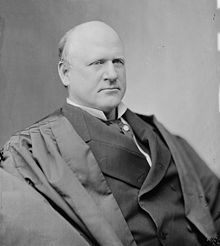
Justice Harlan
The Case of Plessy v. Ferguson involved a Louisianan man of mixed racial heritage who boarded a train designated as useable only by whites. It was against the law in Louisiana at the time to disobey the segregation that took place on transportation and all other manner of life. The man, Plessy, was arrested but challenged the constitutionality of the segregation put in place in Louisiana. The Supreme Court ruled against Plessy in a 7-1 decision in which the court stated that the segregated facilities were “separate but equal.” Many of the Justices cited the autonomy of the state to decide these laws as a reason for deciding against Plessy.

The Effects of the Plessy case
The one Justice who dissented in the case was Justice Harlan. It should be made clear that Justice Harlan was no huge promoter of the equality of races, saying in his dissent, “The white race deems itself to be the dominant race in this country. And so it is, in prestige, in achievements, in education, in wealth and in power.” This statement shows that Justice Harlan himself held some views that would today be considered racist. However his decision to dissent in the case showed that he was remarkably progressive for his time in regards to civil rights. Harlan had the foresight to see that the case involving Plessy would later be seen negatively by historians. Many Justices wish to remain favorably in the eyes of historians in order to ensure that their legacy remains unsullied and Harlan accomplished this task. Harlan himself stated that the Plessy case would come to be seen as negatively as the Dred Scott case. Justice Harlan proved to be on the right side of history with his decision and is still honored to this day for it.

Was Andrew Jackson Right to ignore the Supreme Court?


How Andrew Jackson's Opponents Viewed Him

One of the greatest challenges the Supreme Court has ever faced was when Andrew Jackson refused to follow the will of the Court in regards to a case involving Native Americans in Georgia. The Supreme Court took up the case that challenged President Jackson forcing the Native Americans out of Georgia and ruled in their favor. After the Supreme Court ruled on the case Jackson still defied it, knowing that the Supreme Court did not have the military power to enforce their decisions. Jackson forced the Cherokee Indians out of Georgia and into Oklahoma, leading to the devastating Trail of Tears in which thousands of Native Americans died.

The Trail of Tears
Disregarding historical presentism, the act of viewing history through a modern lens, it is not hard to realize why Jackson forced the Native Americans out of Georgia. As America began to expand it was important to find a way to get rid of the Indian population in frontier territories. The Native American populace posed a threat to frontier settlers, even if imagined, and their presence got in the way of creating new settlements. As a veteran Indian fighter Jackson had experiences fighting Native Americans and was therefore more predisposed to decide against them.

A Map of the Trail of Tears
However I believe that Jackson’s decision to force Native Americans out of Georgia was wrong. I do not believe it is wrong because of the way the Native Americans were treated, but because of the potentially dangerous precedent Jackson could have started. By ignoring the Supreme Court, President Jackson brought to the forefront one of the main problems in the Supreme Court’s power structure, the fact that they did not have the military power necessary to enforce their decisions. Jackson’s actions were a case where the Executive boldly trumpeted its superiority over judicial branch, which influenced future Presidents in their relationship with the Supreme Court. It is lucky that the Supreme Court is able enforce its decisions today, even if they do not have the authority to use military enforcement for their rulings. 

The Dangers and Benefits of Judicial Activism

How Conservatives View Activist Judges

In many conservative circles the word “activist judge” has come to known as a curse word. Conservatives see “activist judges” as destroying many of the core tenants of American culture by: permitting abortion, allowing for the marriage of homosexual and transgendered people, and removing religious aspects from public life. Some conservatives have even gone so far to suggest that “activist judges” be arrested.


I would like to argue that not all judicial activism is bad, and in many cases it can be of great benefit to society. Without judicial activism America would be a very different place than it is now. Thanks in large part to what would now be known as “judicial activism” there is greater equality among American people, at least in terms of race. The ruling in Brown v. Board of Education led to the integration of public schools, which was very unpopular at the time. 

The Victory of Brown v. Board of Education
However, there have also been cases where judicial activism has been used to restrict the rights of the people or to undermine the core democratic values of America. In Citizens United v. Federal Election Commission the Supreme Court ruled that corporations can be treated as people, and therefore can donate unlimited amounts of money to shady Super Political Action Committees that are not “officially” tied to a candidate. This means that the wealthy can essentially buy an American election through almost unlimited resources. The candidates elected by these shadowy Super PACs will also be more likely to support bills that would benefit the interests of the Super PAC and the corporation behind them.

The Dangers of the Citizens United Case
I personally believe that judicial activism can be great for this country, as in Brown v. Board of Education. But there are also great dangers in Judicial Activism, such as in the Citizens United case. I believe that judicial activism should be used to increase equality in America and not be used to support the interests of the wealthy and powerful.